

Greetings readers. The Nike Q4 earnings have finally dropped, so let’s unpack everything that’s happened.
In case you’ve missed it, I released a Pre-Earnings Cheat Sheet earlier this week, based on the overall thesis management has been trying so hard to convey to its shareholders.
Based on the extracted thesis, I identified 25 milestones we should be watching out for in the new Nike earnings drop. Given this performance, we should be able to determine whether the company’s business standing (and investability) has improved, or if any trip wires have been triggered, which would warrant a cut from investor’s portfolio.
👟 Nike (NKE) Pre-Earnings Cheat Sheet — 25 Milestones to Watch

Nike will be releasing earnings next week. Management already prepared us to not expect any major wins.
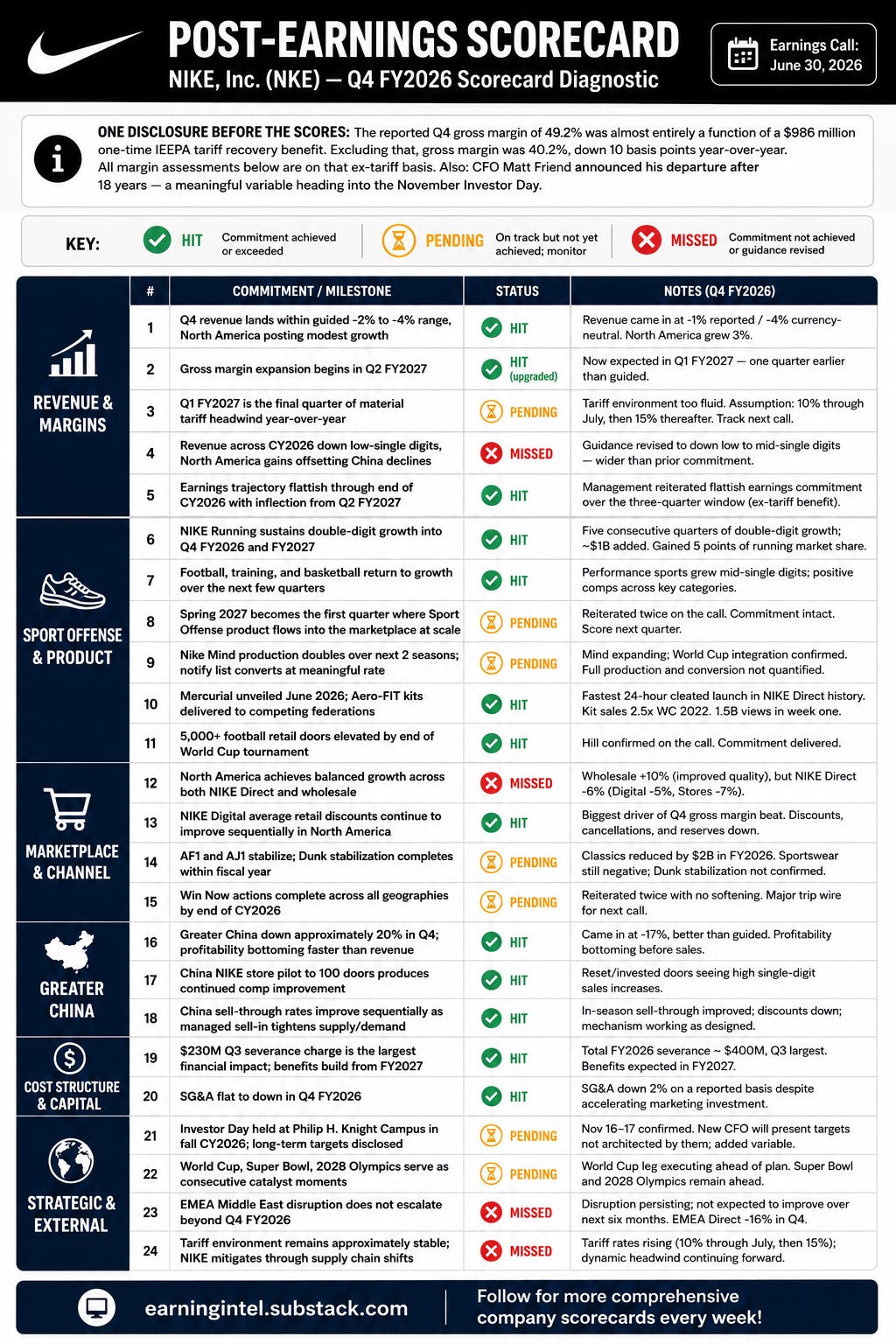
Well since, the earnings have finally come, I’m sticking to my promise, and sharing the post-Earnings scorecard I’ve built:
If this kind of analysis is useful to you, imagine having it built specifically for the stocks you actually hold.
Commissioned scorecards are available — same framework, same depth, built around your portfolio. Know what you own, know what to watch for, and never get caught flat-footed on earnings day.
So How Did Nike Actually Perform?
Honestly, better than management was preparing us for. It’s a smart move to set expectations low, and the over-deliver.
The company delivered well on the North American front, which it was clearly betting big on. It also reported back with positive progress on the Greater China front. There’s ALSO been positive updates on its cost and capital structure.
The things that matter most to the thesis seem to have held.
The Running division hit five consecutive quarters of double-digit growth and added roughly a billion dollars to the business over that stretch.
The World Cup execution was genuinely impressive
Kit sales were 2.5 times the 2022 pace.
The Mercurial became the fastest-selling 24-hour cleated footwear launch in NIKE Direct history, with 1.5 billion views in the first week.
The gross margin inflection got pulled forward one quarter, which is a real positive surprise.
Management reiterated the Spring 2027 Sport Offense ramp and the CY2026 Win Now sunset without any softening of language whatsoever.
These are positive developments.
That being said, however, I still wouldn’t say we have our clean bull case yet.
One big reason for this is that the macro environment showed up mid-quarter in a way that complicated the story.
After a strong March, retail sales decelerated in mid-April, and management attributed it to consumer pressure on discretionary spending and traffic. Of course, this was correlated with gas prices in North America specifically.
Given these pressures, revenue guidance for the forward period was revised from down low single digits to down low to mid-single digits.
This is not a good sign for the company, and its topline guidance being snipped does not play well into the recovery thesis. To make things worse, Sportswear is now explicitly expected to be negative for the entire FY2027 (with improvement only expected in the back half.) Keep in mind, Sportswear and Jordan Streetwear together represent approximately half of NIKE’s entire revenue.
So to sum up, management has now formally deferred any meaningful recovery in its main product categories, pushing it to the second half of 2027. That means the revenue recovery story is essentially a FY2028 story, not FY2027. The sport performance business is working. The brand is rebuilding. But the size of the Sportswear hole means top-line growth is not coming soon.
Then there is the CFO departure, which adds another risk that did not exist before. Matt Friend pretty much architected the financial framework of the entire comeback, so him leaving is definitely a setback. His replacement will be executing on a roadmap they did not design.
So the summary is that while the World Cup is bringing a bit of a boost, and the gross margin path is improving faster than expected, the macro environment delays the company’s comeback plans.
Valuation
At its current ~$41 price, Nike stock trades at 27.5 times its forward GAAP earnings. I find that way too high, given the circumstances the company is sailing through, AND the fact that the median PE ratio in the consumer discretionary sector is closer to 15.
Nike would probably defend that premium by pointing to structural strengths such as athlete relationships, innovation capability, brand equity, wholesale infrastructure, global scale, etc. I would argue, however, that, how valuable could these strengths really be if they cannot be leveraged to ensure a recovery within the projected timeline. Factor into this the macro weakness, and the new risk factor of the CFO’s departure, things seem to definitely have taken a negative turn for Nike.
Therefore, to me, the stock seems pretty clearly overvalued.
This scorecard is for informational purposes only and does not constitute financial advice. All forward-looking statements are derived from management commentary and public filings. Past performance is not indicative of future results. Consult a qualified financial advisor before making investment decisions.
Is it an add, hold, or cut based your preestablished criteria?